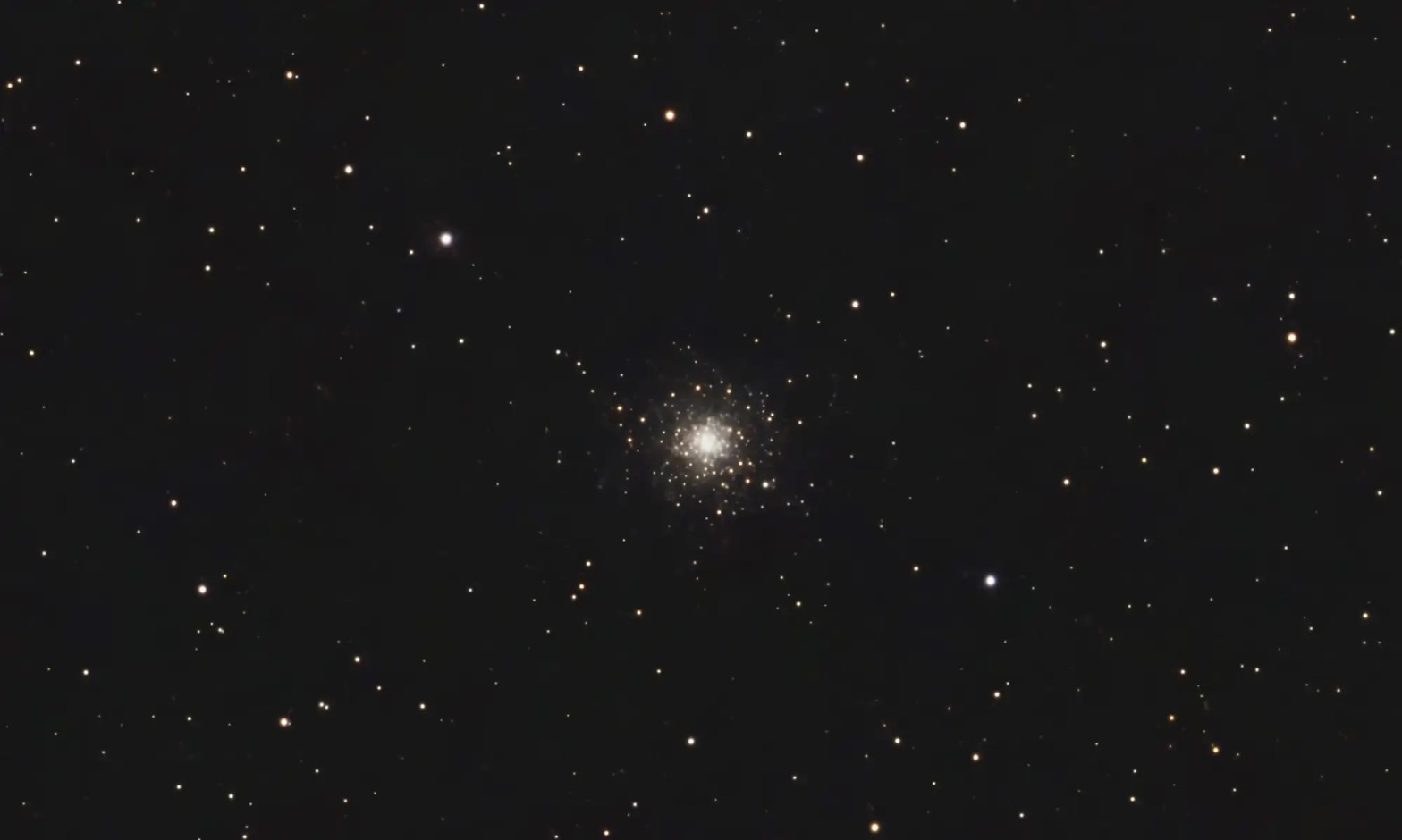
Most globular clusters in the Milky Way are clustered around the galactic center, concentrated in the direction of Sagittarius. Messier 79 ignores all of that. It lies inside the constellation Lepus, the Hare, crouching below Orion’s feet. At around magnitude 8, M79 sits in almost the exact opposite direction from the galactic core, a faint but rewarding target on winter nights.
M79 and the Canis Major Dwarf Galaxy
M79 is about 41,000 light-years from Earth and roughly 60,000 light-years from the galactic center. It’s farther from the core than we are ourselves! Current evidence strongly suggests it may not even be a native of our galaxy. Astronomers believe M79 could be a former member of the Canis Major Dwarf Galaxy, a small satellite galaxy currently being absorbed and torn apart by the Milky Way’s gravity.
A Dense Globular
Despite its unusual address, M79 is not a wallflower. Its core is notably dense and compact, containing around 150,000 stars. What’s more, there’s growing evidence that the cluster may have undergone core collapse. This is the dramatic gravitational process in which stars at the center pack so tightly together that collisions and mergers become common.
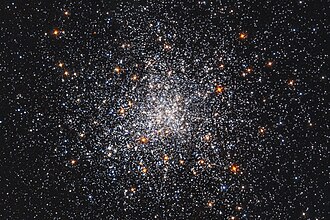
It also helps explain the cluster’s population of blue stragglers. Those are stars that appear surprisingly young and blue in a cluster full of ancient red giants, likely formed when two older stars merged into one.
My Observations
| Date | March 24, 2026 |
| Time | 9:30 p.m. |
| Location | Seattle, WA |
| Magnification | 127x |
| Scope | Meade 8″ SCT |
| Eyepiece | 16mm |
| Seeing | Above Average |
| Transparency | Above Average |
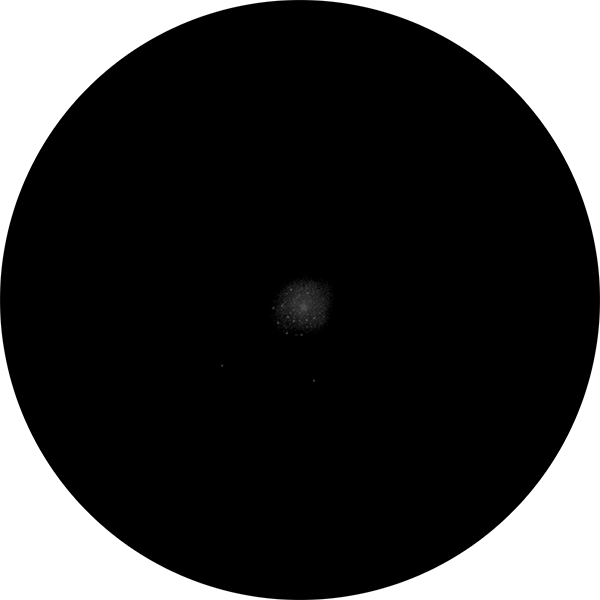
Finding M79 is straightforward once you have Lepus in your sights. Identify Beta Leporis (Nihal), the second-brightest star in the constellation, and sweep about four degrees south. The cluster will appear as a compact, slightly hazy glow. Like other globular clusters, once you know it’s there, it seems impossible to miss.
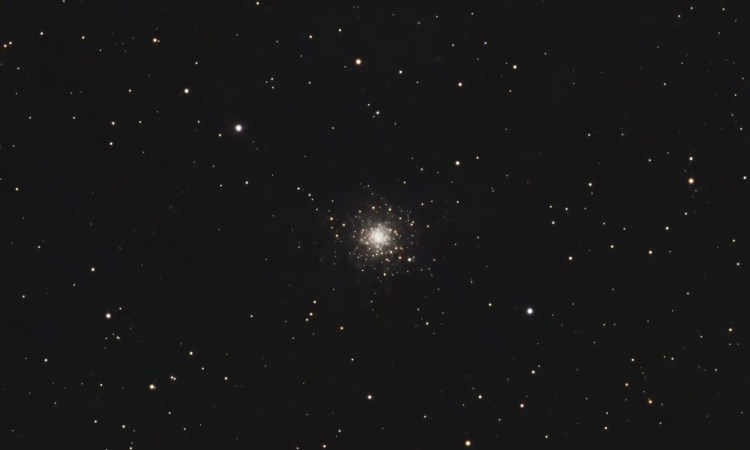
What I find endlessly satisfying about this target is the reminder of just how far outside the ordinary it sits. Most of my globular hunting takes me toward the summer Milky Way.
Key Stats
| Constellation | Lepus |
| Best Viewing | Winter |
| Visual Magnitude | +7.7 – +8.5 |
| Distance from Earth | ~41,000 light-years |
| Diameter | ~118 light-years |
| Apparent Size | 9.6 arcminutes |
| Milky Way Location | Galactic Halo |
| My Viewing Grade | B |
| Other Designations | M79, NGC 1904, GCl 17 |
Historical Observations
October 26, 1780: Discovery by Pierre Méchain
M79 was discovered not by Messier himself, but by his trusted colleague and fellow comet hunter, Pierre Méchain, on the night of October 26, 1780. Méchain reported the find to Messier, who observed it himself on December 17th and added it to his catalog. Messier described it as follows:
“Nebula without star, situated below Lepus, & on the same parallel as a star of sixth magnitude: seen by M. Méchain on October 26, 1780. M. Messier looked for it on the following December 17: this nebula is beautiful; the center brilliant, the nebulosity a little diffuse; its position was determined from the star Epsilon Leporis, of fourth magnitude.”
For more historic descriptions, visit: http://www.messier.seds.org/Mdes/dm079.html
Sources and Notes
Banner image and sketch: Wayne McGraw
Wikimedia Foundation. (2026). Messier 79. Wikipedia. Retrieved March 2026, from https://en.wikipedia.org/wiki/Messier_79
Frommert, H. & Kronberg, C. Messier 79. SEDS Messier Database. Retrieved March 2026, from http://www.messier.seds.org/m/m079.html
NASA Science. (2024). Messier 79 (NGC 1904). Hubble Messier Catalog. Retrieved March 2026, from https://science.nasa.gov/mission/hubble/
 The Garden Astronomer