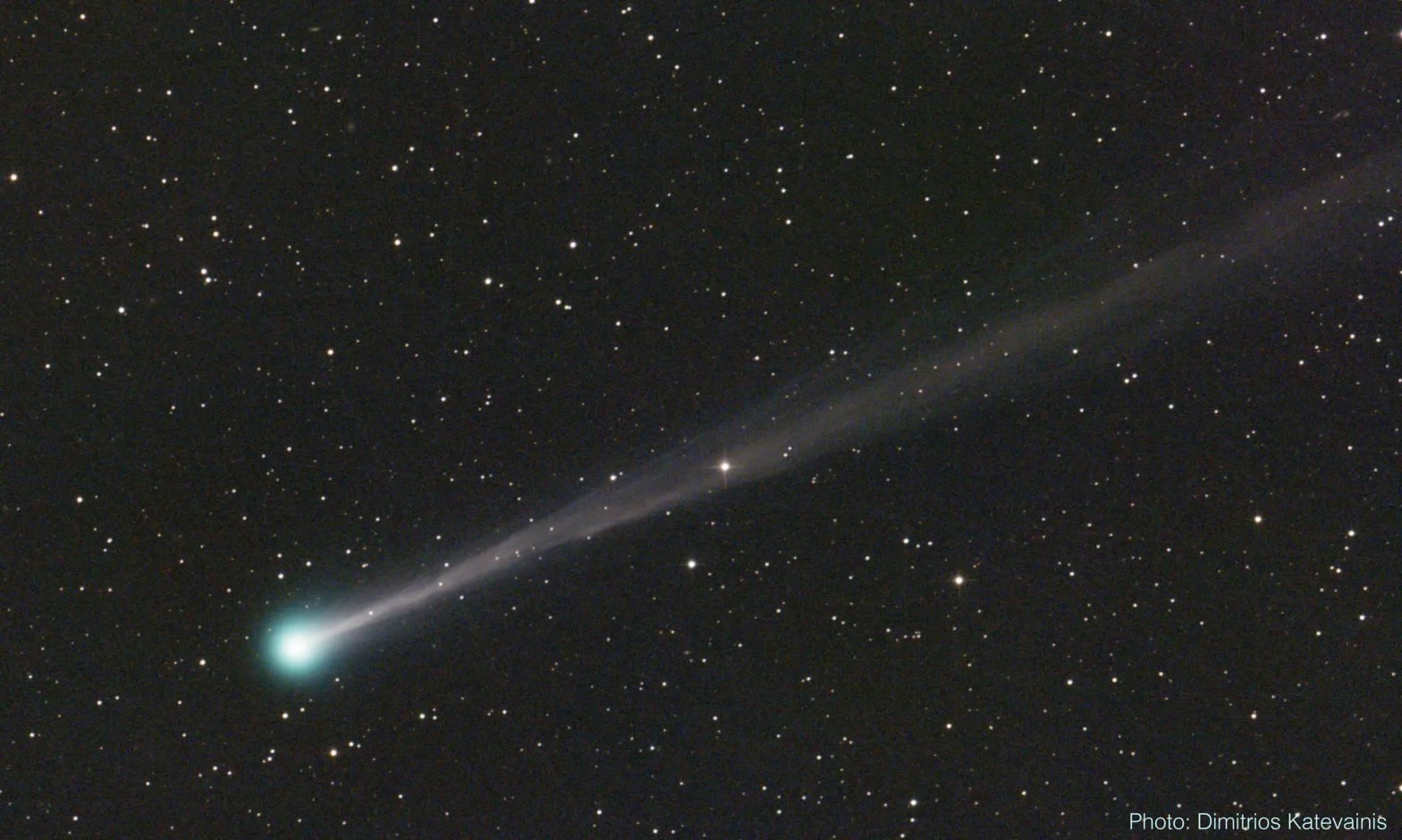
Discovery in Hawaii
Comet C/2025 R3 was discovered on September 8, 2025, by the Pan-STARRS survey telescope perched atop Haleakalā in Hawaii. At the moment of discovery, it was a faint magnitude-20 wisp, invisible to anything but the most sensitive instruments on Earth. Yet here it is now, brightening daily, as it inches closer to the sun.
Ongoing Observations
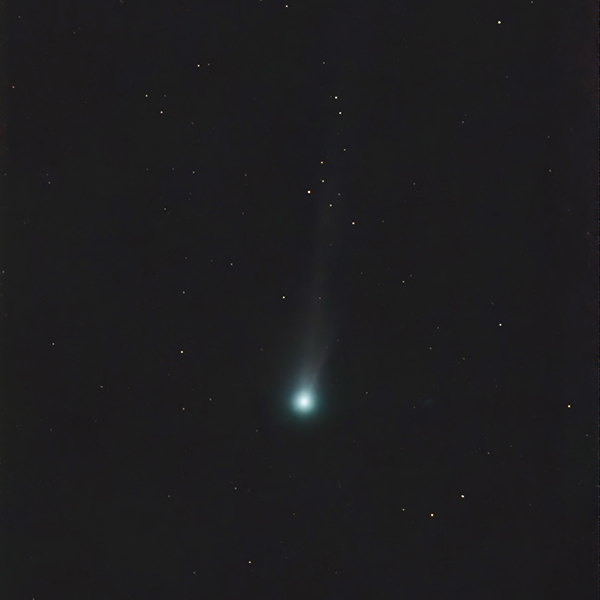
April 11, 2026, at 5:50 a.m.
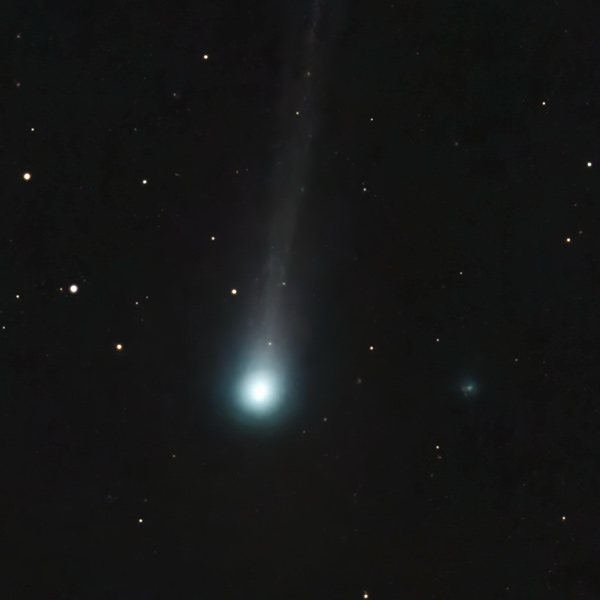
The Gulf Coast has had a fair share of party cloudy weather for the better part of a week, but a high-pressure system is pushing through, and the skies are beginning to open up. This morning, the stars of Pegasus are visible, along with the prominent “W’ of Cassiopeia further north. I start scanning above the rooftops with binoculars, hoping to pull out a faint smudge the way I did with Comet C/2025 R2 (SWAN) back in October. No luck this morning. There’s a lingering haze on the horizon. I’ve fired up the Seestar S50 on the front porch and captured the comet.
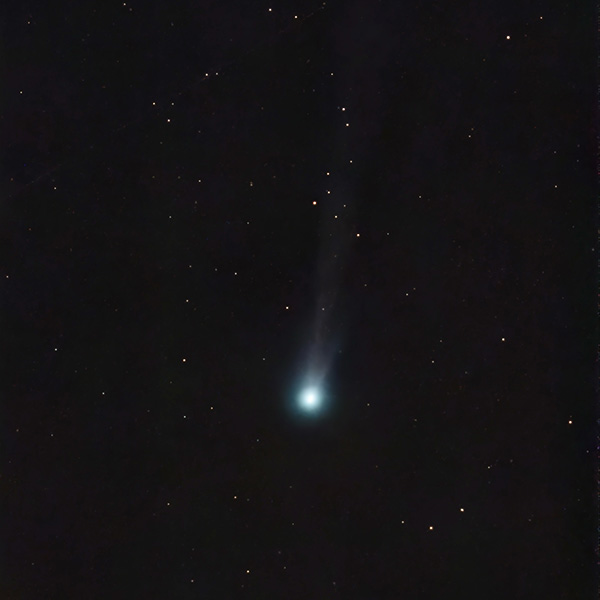
April 13, 2026, at 5:45 a.m.
The high-pressure front is dominating the area, but I’m contending with a hazy cloud layer this morning. No sign of the comet in binoculars, so I decided to shoot with Seestar again. In the cropped photo, I’m noticing faint nebulosity right of the comet’s head. Still researching if this is a distant galaxy, as several are in this region.
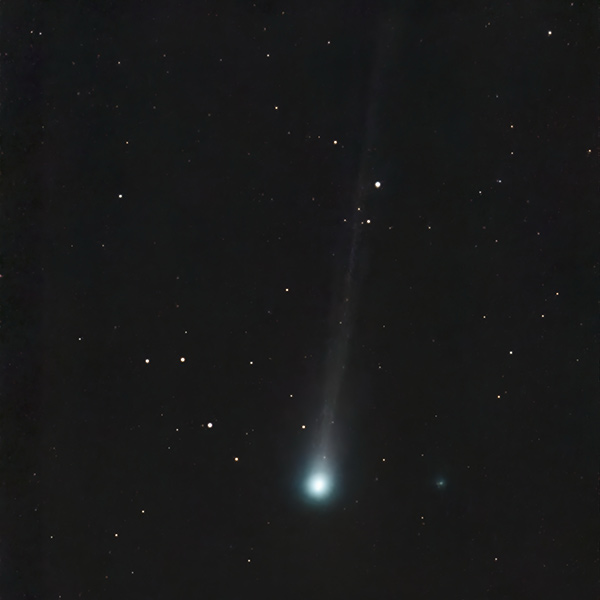
When and Where to Look
Right now, the comet is riding through the constellation Pegasus, moving across the bottom of the Great Square from the star Markab toward Algenib. For observers in the Northern Hemisphere, the prime window is this week. Head outside about 90 minutes before sunrise and face the eastern horizon. The comet will be low, only 10 to 12 degrees above the horizon, roughly the width of a closed fist held at arm’s length.
A few key dates:
April 13–15: The comet sits within the Great Square of Pegasus, roughly 15 degrees above the horizon an hour before sunrise. This is one of the best windows for Northern Hemisphere observers.
April 17: New Moon. The darkest skies of the month are centered on this date, giving the comet the best possible backdrop.
April 18: The comet passes within 2 degrees of the edge-on spiral galaxy NGC 7814. If you can capture both in the same field of view, you will have one of the more striking astrophotographs of the year.
April 19–20: Perihelion — the comet’s closest approach to the sun at about 0.499 AU, or roughly 75 million kilometers. This is expected to be its peak brightness. By late April, the viewing advantage shifts to the Southern Hemisphere, where it will emerge as an evening object.
170,000 Years in the Making
This is a long-period comet, born in the distant Oort Cloud. Its trajectory is hyperbolic, meaning after it swings around the sun this spring, it will be flung outward into interstellar space, never to return. The last time this particular chunk of ice and dust swept through the inner solar system was around 170,000 years ago!
Sources and Notes
Banner photo by Dimitrios Katevainis, via Wikimedia Commons (CC BY-SA 4.0).
Carter, J. (2026, April 10). Why I’m hunting for Comet Pan-STARRS right now — before it’s too late. Space.com. https://www.space.com/astronomy/comets/why-im-hunting-for-comet-pan-starrs-right-now-before-its-too-late
TheSkyLive. (2026, April 12). Comet C/2025 R3 (PANSTARRS): Complete information & live data. https://theskylive.com/c2025r3-info
Wikipedia contributors. (2026, April 13). C/2025 R3 (PanSTARRS). In Wikipedia, The Free Encyclopedia. https://en.wikipedia.org/wiki/C/2025_R3_(PanSTARRS)
 The Garden Astronomer