
Not far from Virgo’s beautiful blue Spica is the double star Gamma Virginis. Also known as Porrima, this star is the second brightest in the springtime constellation of Virgo. At first glance, from a suburban location with light pollution, Porrima appears as a dim, white star. However, looking through the telescope, one will find twoContinueContinue reading “Gamma Virginis “Porrima”: Twins Pulling Apart”
Category Archives: Double/Multiple Stars
Mizar: A Double Star Known for Generations

My guess is Mizar is the first double star most people ever see. When Ursa Major (the “Big Dipper”) takes its place high in the springtime sky, casual skygazers can point out the bright double star in the middle of the ladle called Mizar. Its companion, called Alcor, shines almost as bright, making both starsContinueContinue reading “Mizar: A Double Star Known for Generations”
Pi Bootis: A Pair of White Stars in Bootes

The prominent springtime constellation Boötes contains a host of nice double stars. Like the colorful double star Xi Bootis in Bootes, Pi Bootis is a naked eye object under darker sky conditions with a magnitude of +5. While the pair is fairly bright, they are close in proximity, so you will need at least aContinueContinue reading “Pi Bootis: A Pair of White Stars in Bootes”
Xi Bootis: A Yellow and Reddish-Violet Double in Bootes

The prominent springtime constellation Boötes contains a host of nice double stars. One, in particular, XI Bootis, is a rare sight because it’s a naked-eye object with a mass and luminosity less than our sun. The primary star is 90% of the mass and 83% of the radius of the Sun. Due to XI Bootis’ContinueContinue reading “Xi Bootis: A Yellow and Reddish-Violet Double in Bootes”
Mu Boötis: A Triple Treat of Stars
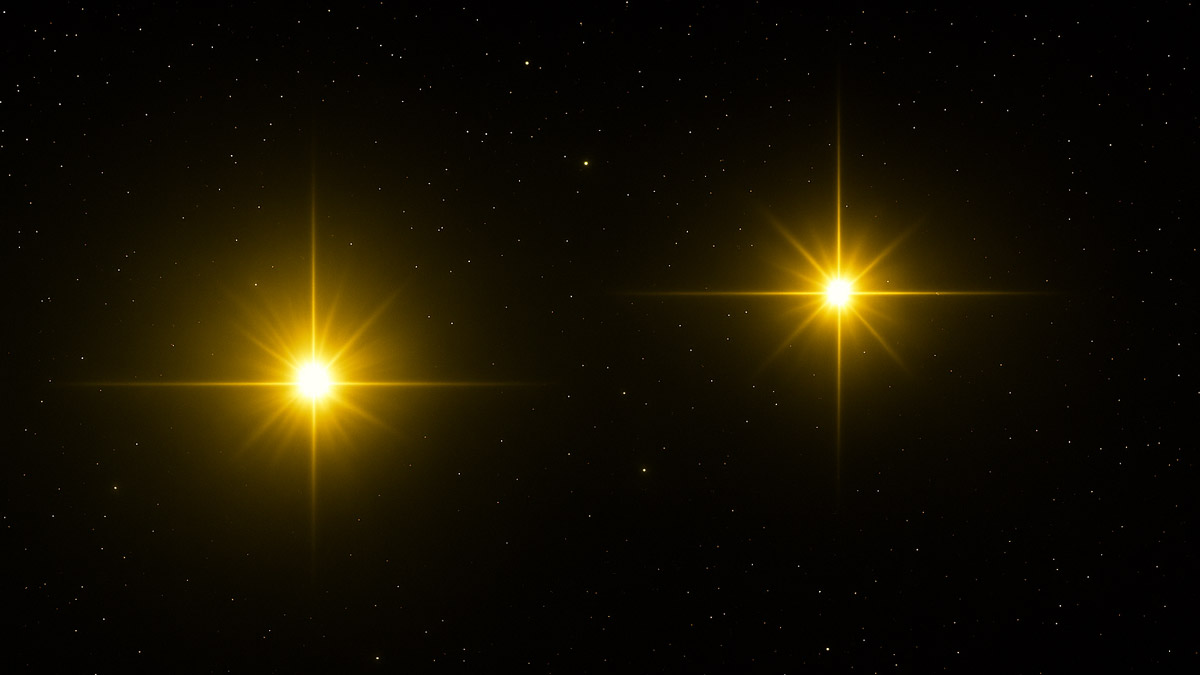
Mu Boötis is a spring treat for those who enjoy observing multiple star systems. The system’s proper name is Alkalurops, which means “club” in Greek and represents a shepherd’s staff. With the naked eye from a dark site, one can see the primary star, Alkalurops A. It has a yellow, white color. Nearby are theContinueContinue reading “Mu Boötis: A Triple Treat of Stars”
Polaris: Celebrated North Star and Triple Star System

Polaris, known as the North Star, is a triple-star system located 433 light-years from Earth. The primary star, Polaris A, is a yellow supergiant and a Cepheid variable, with two companions. Although it appears singular, Polaris is a complex system, offering astronomers a tool for measuring cosmic distances. This article shows how it appears in an 8-inch SCT telescope under suburban skies.
HR 4893: A Pretty Double Near the North Celestial Pole

Up near Polaris, the North Star, there are a number of good double stars. The ever popular Mizar in Ursa Major comes to mind. Another double star bright enough with good separation is Nu Draconis in Draco. In this same region is a double star system called HR4893 in the constellation Camelopardalis. It appears HRContinueContinue reading “HR 4893: A Pretty Double Near the North Celestial Pole”
Arcturus: The Great Light Switch of the Chicago World’s Fair

Whenever I see Arcturus, I imagine standing with 30,000 other people at the opening of the Chicago World’s Fair on May 27, 1933. At 9:15 that evening, observatories in four locations across the eastern U.S. aimed their scopes on Arcturus. The bright star’s light set off photocells at each location. In turn, these devices sentContinueContinue reading “Arcturus: The Great Light Switch of the Chicago World’s Fair”
 The Garden Astronomer