
Messier 24 is not a traditional astronomical object like a nebula, star cluster, or galaxy. Instead, it is a region within our Milky Way galaxy that is densely packed with stars, making it appear like a stunning celestial cloud.
Category Archives: Star Clusters
Messier 11 (NGC 6705): A Wild Duck Swims Through Scutum
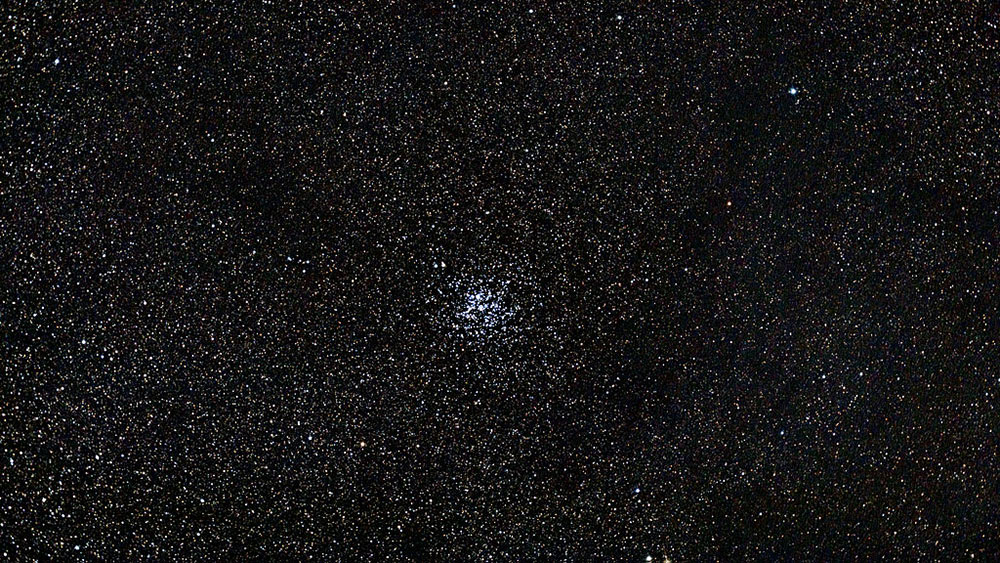
Backyard astronomers will appreciate Messier 11’s bright magnitude, which allows this “cloud” of more than 2,900 stars to be viewable under good conditions. Also known as the Wild Duck Cluster and NGC 6705.
Struve 1659: The Stargate Cluster (Asterism) in Corvus

Learn about the star cluster Struve 1659 also known as the Stargate Cluster. The object is an asterism in the southern constellation of Corvus best viewed from the Northern Hemisphere in the spring.
Messier 44 (NGC 2632): A Swarm of Bees in Cancer

From Ptolemy describing M44 as a “nebulous mass in the breast of cancer” to Chinese astronomers calling it a “cloud of pollen,” the Beehive has held the attention of skywatchers over the ages. Also known Messier 44, Praesepe, and NGC 2632.
Messier 67 (NGC 2682): The Ancient King Cobra Cluster

Messier 67, also known as the King Cobra cluster or NGC 2682, is an open star cluster in the constellation of cancer. It’s best viewed in late winter and early spring. It is one of the oldest known star clusters and contains more than 500 stars!
NGC 1502: A Rich Cluster Meets a Cascade of Stars

NGC 1502 is a rich, attractive open star cluster in the constellation Camelopardalis. The cluster lies at one end of the notable asterism Kemble’s Cascade. Backyard astronomers will larger binoculars or smaller scopes will enjoy seeing both!
Messier 36 (NGC 1960): A Pinwheel of Stars

Messier 36, nicknamed the Pinwheel Cluster, is an open cluster in the constellation of Auriga. It is best viewed in winter through early spring. Approximately 60 stars make up the cluster, with many of the brightest stars making straggling lines or chains streaming from the center.
Messier 37 (NGC 2099): A Diamond Starburst in Auriga

M37 is one of the most beautiful clusters in the northern winter sky. It resides in the constellation Auriga. it fills a wide-field eyepiece wonderfully.
 The Garden Astronomer