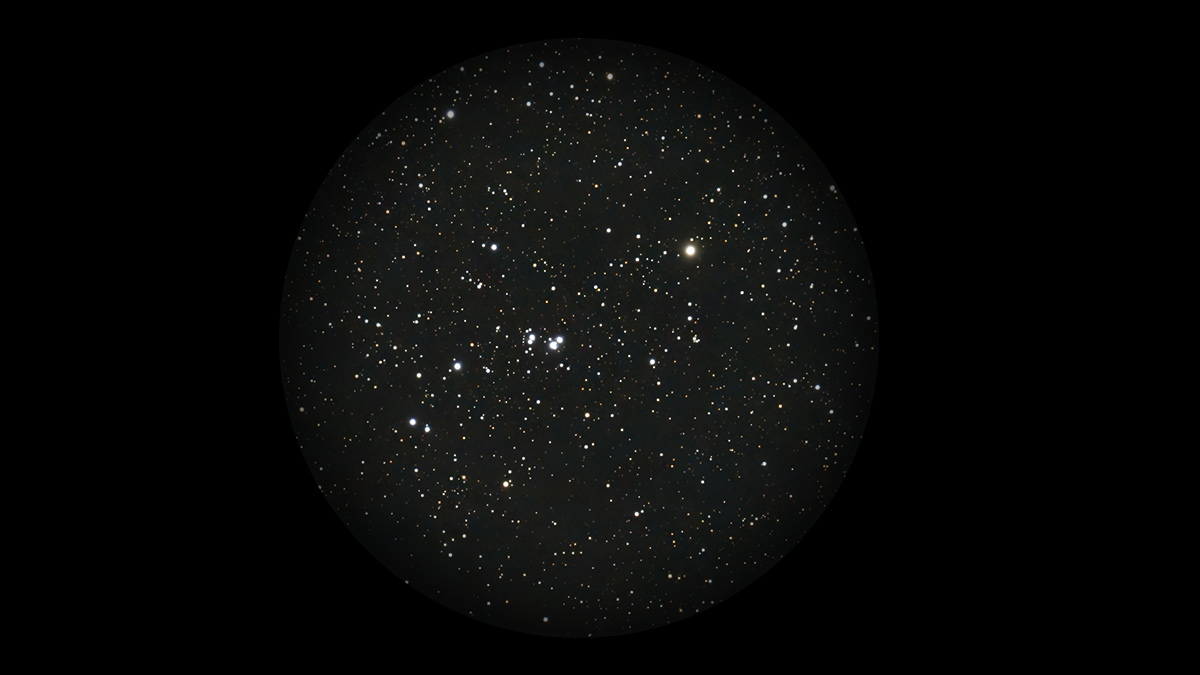
Discovered in 1825, NGC 6871 is an open cluster in the constellation of Cygnus. It’s best viewed in summer and early autumn.
This is a young cluster, only 9 million years old, with approximately 50 stars. A majority of the stars are blue and white in color. At first glance, this may appear as a sparse, yet attractive summer cluster. Look closer, and there’s more the celebrate about the object.
Notably, the cluster has a pair of double-star systems. Also, the brightest member star is a Wolf-Rayet star, WR 133. And last but not least, it has eclipsing binaries. To learn more about these stars, I suggest reading Francis Reddy’s overview on Astronomy.com.
My Observations
| Date | September 5, 2020 |
| Time | 10:10 p.m. |
| Location | Seattle, WA |
| Magnification | 127x |
| Scope | Meade 8″ SCT |
| Eyepiece | 16mm |
| Seeing | Above Average |
| Transparency | Average |
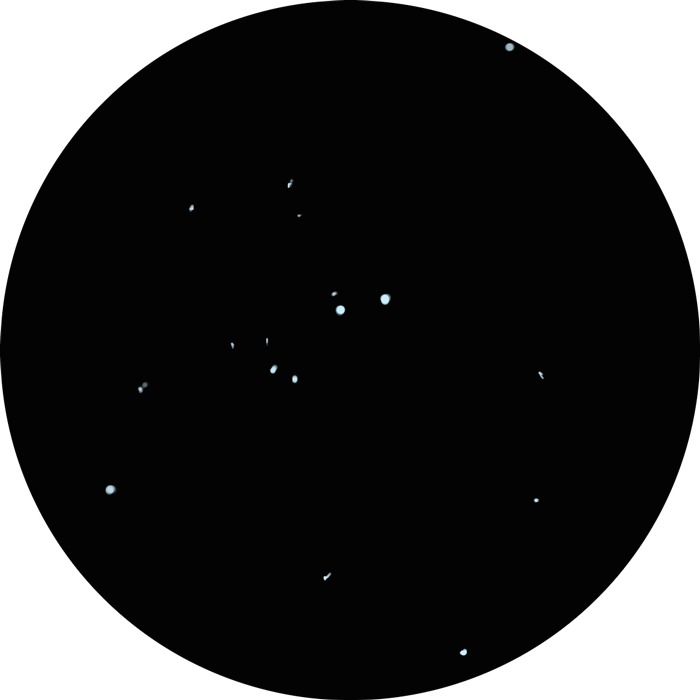
When reviewing my list of open cluster targets in Cygnus, I didn’t expect much from NGC 6871 based on my initial reading. Upon seeing the cluster, it’s surprisingly engaging. It is dominated by a pair of double stars.
Seestar S50 Observation on October 15, 2025, Tampa, Florida
Last night, I revisited NGC 6871—this time not through the eyepiece, but with my Seestar S50. As the stacked exposures came together on the screen, I was struck by how photogenic it truly is. Against the dark Cygnus backdrop, the cluster sparkles with subtle variety. The cluster is an understated gem that rewards both the observer and the imager.

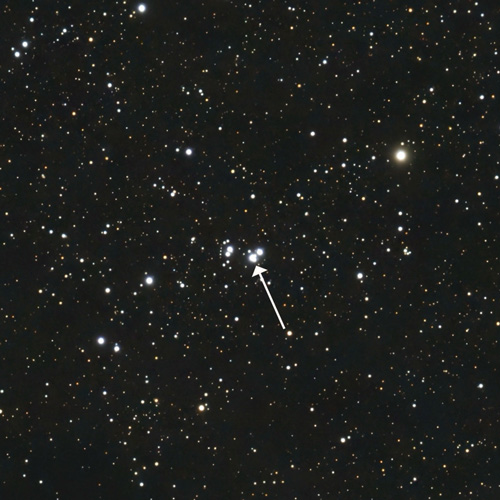
The photo below shows the Wolf-Rayet star called WR 133. The arrow in the image points to a remarkable pair of massive stars in or near the star cluster NGC 6871 in the constellation Cygnus.
One of the stars is a rare type called a Wolf–Rayet star, an extremely hot, bright star that has blown off much of its outer material through powerful stellar winds. Its companion is also a very hot, massive star.
Because the two stars orbit each other, scientists can study how their intense energies interact. Systems like this don’t last long in cosmic terms, so finding one gives astronomers a valuable look at a brief stage in the life of the universe’s most massive stars. WR 133 stands out in its neighborhood, adding interest to an already beautiful and active region of the sky.
Key Stats
| Constellation | Cygnus |
| Best Viewing | Summer |
| Visual Magnitude | +5.2 |
| Absolute Magnitude | -5.8 |
| Distance from Earth | 5,134 ly |
| Diameter | 43 ly |
| Apparent Size | 29 arcmin |
| Milky Way Location | Orion Spur |
| My Viewing Grade | A |
Sources
Sketch and photos by Wayne McGraw
De Becker, M., et al. (2019). Hints about the multiplicity of WR 133 based on multiepoch JVLA observations, Astronomy & Astrophysics, 626, A138. https://doi.org/10.1051/0004-6361/201834493
 The Garden Astronomer
One thought on “NGC 6871: A Simple Sparkling Cluster in Cygnus”