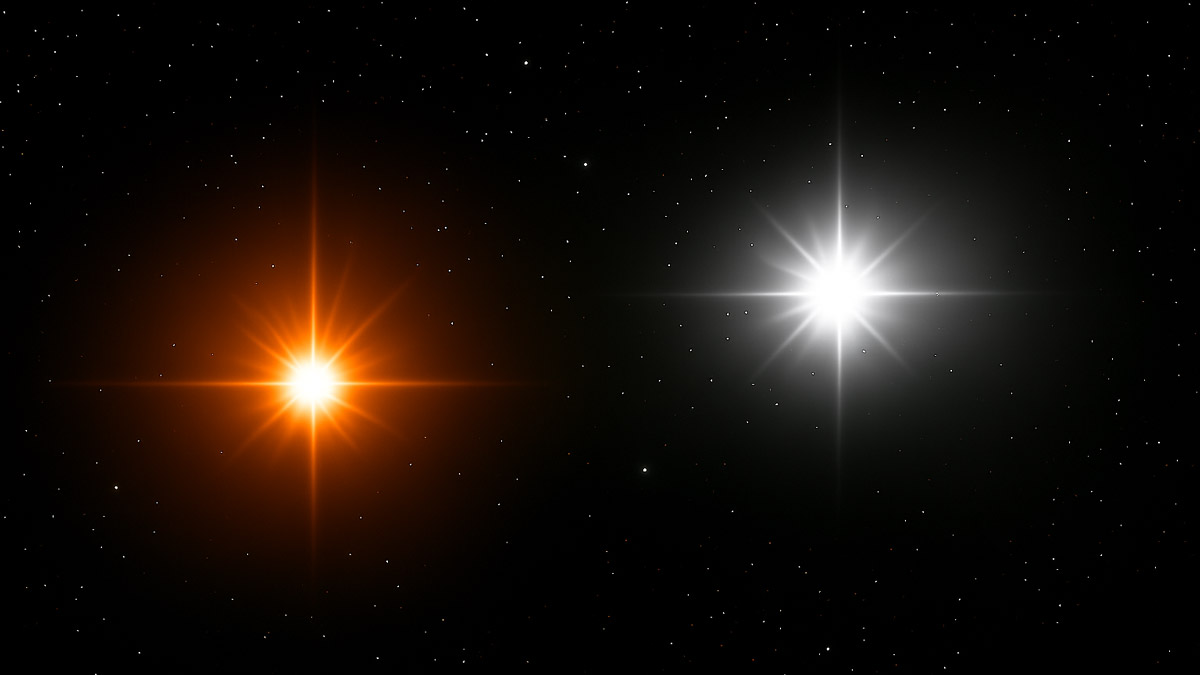
Nestled in the northern constellation of Canes Venatici, Latin for “the Hunting Dogs,” the double star 2 Canum Venaticorum (also known as Struve 1622) offers a captivating sight for those who love double stars. Observers can catch this pair in the northern sky in the spring and early summer months near the more famous constellation Ursa Major. The double star is also known as SAO 44097, 2 CVn, STF 1622, HIP 59827, HD 106690, HR 4666.
Tag Archives: Double Star
6 (Iota) Trianguli: A Bronze and Blue Binary in the Constellation Triangulum

Triangulum is a distinctive northern constellation best observed in autumn and winter, featuring the Messier 33 galaxy and notable double stars like 6 Trianguli. Discovered by William Hershel, this binary system consists of a primary G5 giant and a fainter F5 dwarf star. It is a quadruple system with spectroscopic binaries.
14 Aurigae (Struve 653): A Multiple Star System in Auriga

14 Aurigae, a prominent multi-star system in the Auriga constellation, features a bright primary star of +5 magnitude while the dimmer secondary appears blue. The stars are 286 light years away and separated by 14 arcseconds. As part of the Orion Spur in the Milky Way, 14 Aurigae provides insights into stellar evolution.
15 Aquilae: An Attractive Orange and Yellow Double in Aquila

15 Aquilae, also known as h Aquilae, is a pretty orange-yellow double star in the summer constellation of Aquila, which also happens to lie on the celestial equator.
12 Comae Berenices: A Bright Double Star Greets You in Coma Berenices

12 Comae Berenices is a pretty double star in the northern constellation of Coma Berenices. At a magnitude around +4.8, backyard astronomers can enjoy this bright binary on spring nights.
88 Leonis (Struve 1547): A Fairly Wide Binary in Leo
88 Leonis, also cataloged a Struve STF 1547, is a fairly bright binary star in the constellation Leo. This double star is a popular target in spring skies due to its brightness and wider 15.3 arc seconds of separation.
6 Leonis: A Glowing Orange Star with a “Dusky” Companion
6 Leonis is a double star in the constellation Leo. The primary star is a orange-red giant with a secondary star positioned 37″ arc seconds away.
12 Lacertae: Crystal Blue Double

Discover 12 Lacertae, a crystal blue double star in Lacerta. The primary is a Beta Cephei variable (mag 5.16-5.28). Observations & key stats!
 The Garden Astronomer