I realize visitors to this site may have varying levels of experience with astronomy. Some may know the night sky intimately, while others are brand new to the hobby. Here are several tips divided by experience level.
Beginner Amateur Astronomers
If you are starting out, a plethora of books, apps, and websites are available to help you on your learning journey. At this time, I don’t provide instruction on basic sky navigation, including how to hop from constellation to constellation or star to star. However, I’ve listed my individual observations in several ways to make jumping in easier.
Hover over “Observations” on the top menu. You’ll find observations listed by date, constellation, and by their type (i.e., star cluster, Messier object, and more.) I suggest starting out by selecting “Date.”
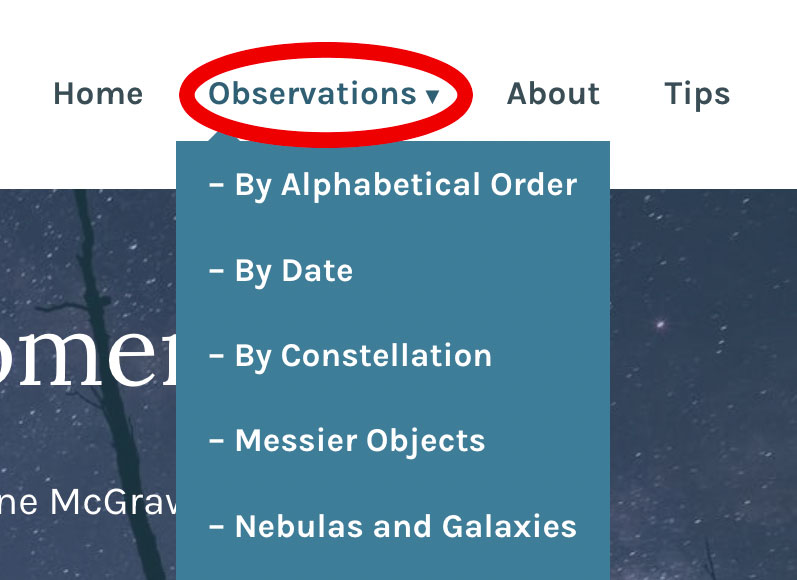
For example, if it’s wintertime where you’re at, browse through targets around November through March. I’m afraid I only provide guidance based on my observations from the northern hemisphere. Once you find a few objects you want to see, open up any astronomy app, search for the object’s name, and navigate your way with the aid of the app. You’ll find wonderful apps and programs on the market to get you started. My favorite apps are Sky Guide for Apple products, while Sky Safari runs well on both Android and Apple.
If you are viewing from a light polluted area, such as the suburbs, I suggest trying your hand at discovering targets that are generally brighter. Look for planets, double stars, and star clusters. On the other hand, galaxies and nebulas can be tougher to uncover with brighter skies.
In general, you’ll find that my comments on each individual observation page will fill you in on how tough the object may be to see. Unfortunately, we city and suburban dwellers need a pair of binoculars or a telescope to pick out targets. If anything, don’t give up. Also, I suggest observing on nights with little to no moon to cut down on sky glare. Furthermore, use a free stargazing site or app, such as Clear Sky Chart. Try observing on nights when Clear Sky Charts indicates you’ll have cloudless nights as well as good “Transparency” and “Seeing” conditions. Learn more about this helpful resource in this Sky & Telescope article.
Lastly, if you own a telescope with a built-in computerized motor, take advantage of the onboard computer. This will help tremendously since it can be discouraging to navigate manually with dimmer stars. I stand with many experienced amateur astronomers who say it’s important to learn the fundamentals of sky navigation using your eyes and a pair of binoculars. This is how I observed for many years of my life. At the same time, however, the growing problem of light pollution makes it harder and harder to sail from object to object with no assistance. With my computerized scope, I now spend less time finding my way around and more time enjoying what the universe has to offer.
Intermediate Amatuer Astronomers
Under the “Observations” menu, you’ll find observations listed by date, constellation, and type (i.e., star cluster, Messier object, and more.) If you want to see all the options, click “All Observations” on the home page.

Also, please use the search bar. As part of my ongoing site improvements, I’ve been tagging each observation page with more details, such as NGC, IC, and SAO numbers when available. You also don’t need to spell out Messier if searching for those. Simply type “M” in front of the number.
The goal of this site
I’m not trying to compete with all the great and comprehensive software available. This website is simply my attempt to compile my personal observations in a way that is friendly and easy to use. My hope is that it helps others, especially those trying their best under light-polluted skies. As I noted in the beginner’s section above, all the entries are based on my location in the northern hemisphere.
I’m always open to suggestions, so feel free to leave comments on this page. Clear skies!
 The Garden Astronomer