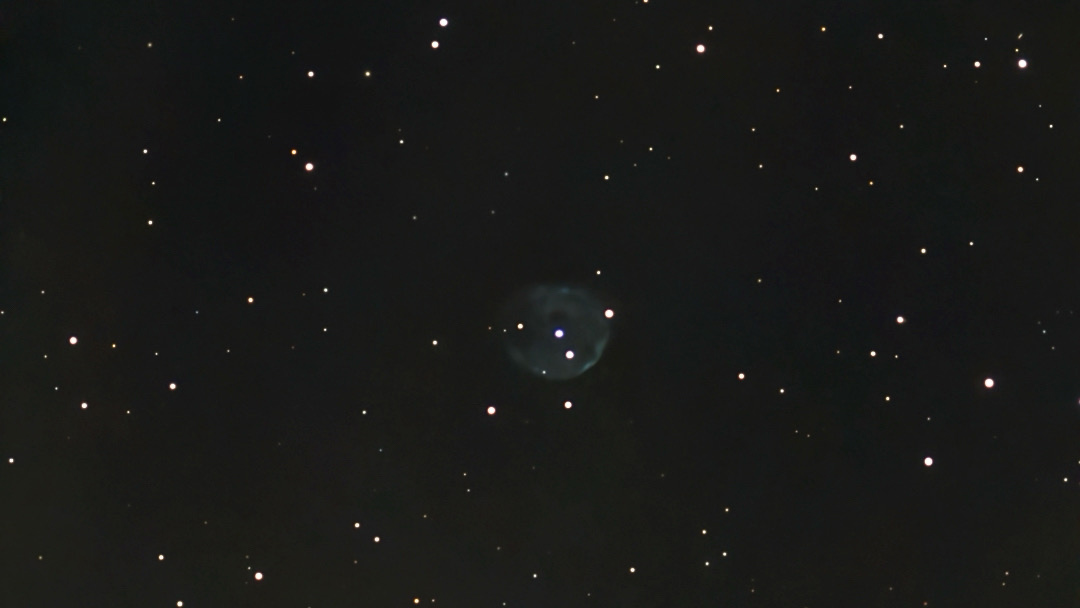
The Skull Nebula, or NGC 246, is tucked away in the constellation Cetus, the Whale. It’s an eye-catching sight with an eerie shape that has captured the interest of astronomers and stargazers alike, thanks to its unusual appearance. William Herschel first discovered the nebula more than 200 years ago in 1785.
A Cosmic Ghost Story
NGC 246 earned the nickname “Skull Nebula” because of its distinctive appearance in telescopes and astrophotography. The planetary nebula has a roughly circular shape with darker regions inside that resemble the eye sockets and nasal cavity of a human skull.
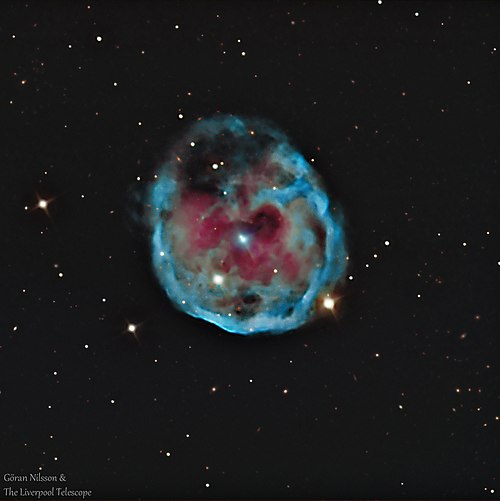
Credit: Göran Nilsson & The Liverpool Telescope
Creative Commons
As NASA points out, this skull pattern is essentially a coincidence of how the gas is distributed and lit. Planetary nebulae like NGC 246 are formed when a dying star sheds its outer layers, leaving behind a hot core (a white dwarf) that illuminates the expelled gas. For a few other examples of these nebulae, read my observations on the Dumbbell, Blue Racquetball, Ring, and the Owl Nebula.
The Star at the Heart of the Skull
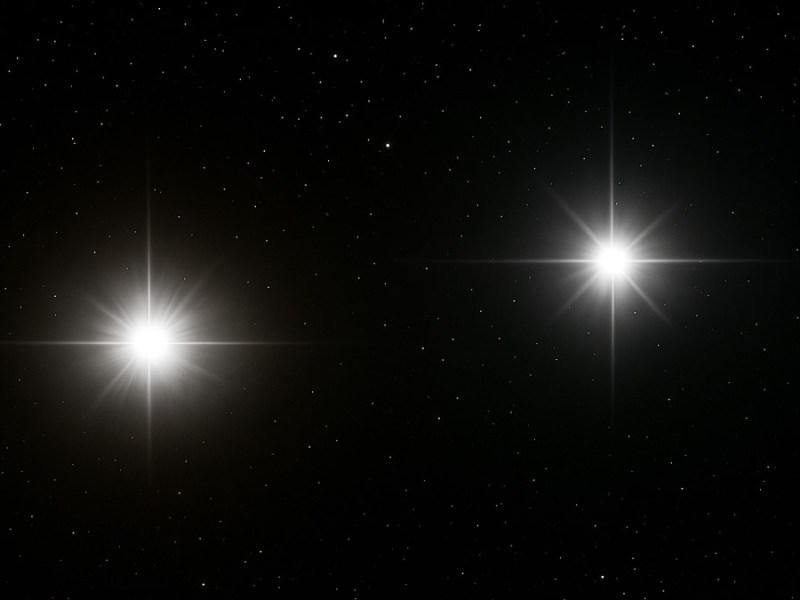
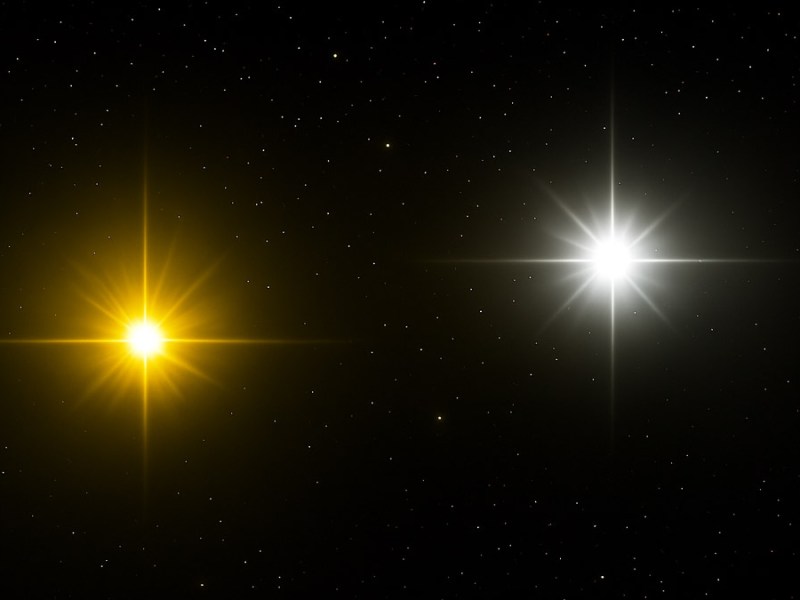
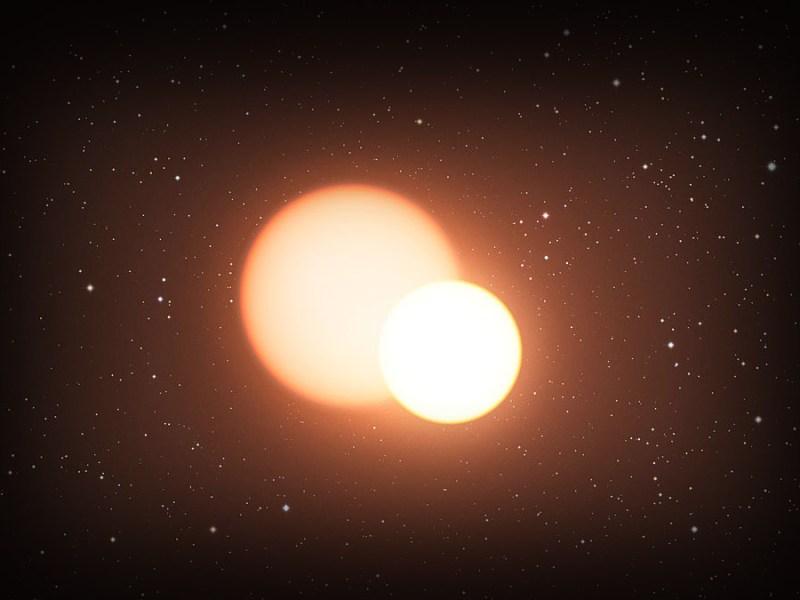
The main star lighting up NGC 246 is a white dwarf called HIP 3678 A, which shines at 12th magnitude. This small but heavy remnant is all that’s left of a star like our Sun, now squeezed down to about the size of Earth.
But that’s not all. Astronomers discovered that NGC 246 is the first known planetary nebula with three stars at its center. The white dwarf is joined by two companions: HIP 3678 B, which orbits nearby, and HIP 3678 C, a red dwarf. You can read more on this at Oxford Academic. Together, these stars move in a complex dance, with the white dwarf leading the way.
Observing the Skull Nebula
For amateur astronomers, NGC 246 can be both tricky and rewarding to spot. In northern areas, it stays low in the sky, only reaching about 26 degrees above the horizon, which makes it harder to see clearly. Still, many dedicated observers have managed to observe its ghostly glow from July to February.
The Skull’s Eternal Vigil
As NGC 246 continues its journey through space, growing and changing, it reminds us that nothing lasts forever, not even stars. Its haunting beauty carries a message of change and new beginnings. But for now, the Skull Nebula will continue to glow for millennia, a luminous monument to the star that created it and a beacon guiding us toward a deeper understanding of our place in the cosmos.
My Observations
| Date | November 23, 2024 |
| Time | 10:48 p.m. |
| Location | Tampa, FL |
| Magnification | 135x |
| Scope | Meade 8″ SCT |
| Eyepiece | 15mm |
| Seeing | Above Average |
| Transparency | Above Average |
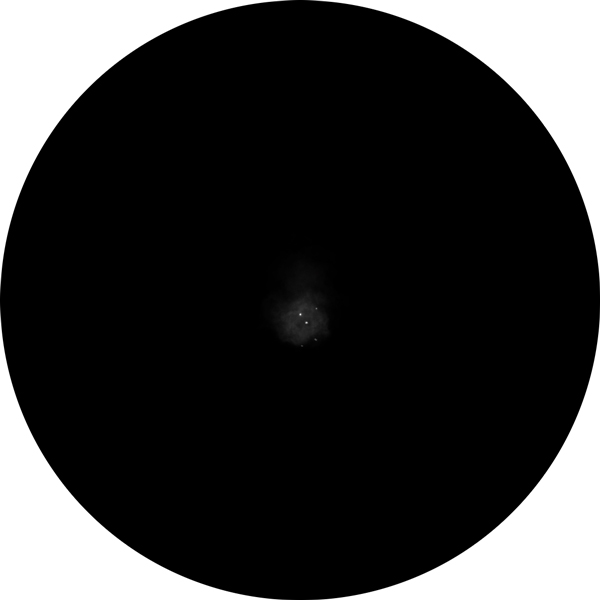
Like many planetary nebulae I’ve observed, the Skull Nebula demands patience at the eyepiece. It takes time for my eyes to adjust, using averted vision to help make it more noticeable. The two brighter stars, resembling eyes, serve as helpful guides to locate the correct star field. However, despite their assistance, the nebula itself appears faint and subtle—a delicate ghost of light against the dark sky.
Photo observation with Seestar S50 from Tampa, Florida, on November 23, 2024
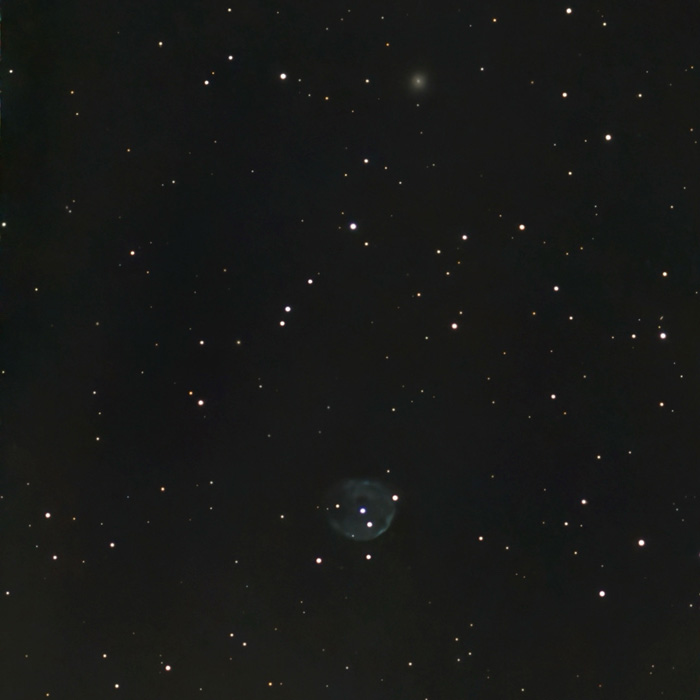
With a little time off from work for the Thanksgiving holiday, I’ve spent my night navigating the skies with the Seestar, while watching for any lurking alligators nearby! The Skull Nebula is dim, yet fascinating. The photo below was taken over 67 minutes using 10-second exposures under fairly bright suburban skies.
I was excited to see that the Seestar left me a surprise at the top of the photo. Upon researching, the glowing small circular light in the frame is NGC 255, an 11th-magnitude spiral galaxy.
Key Stats
| Constellation | Cetus |
| Best Viewing | Winter |
| Visual Magnitude | +8.1 |
| Absolute Magnitude | -1.5 |
| Distance from Earth | ~ 3,500 light-years |
| Diameter | ~ 2-3 light-years |
| Apparent Size | 3.8 × 3.8 arcminutes |
| My Viewing Grade | B |
| Designations | NGC 246, Caldwell 56, Skull Nebula, Pac-Man Nebula, ARO 43, HIP 3678, WDS J00470-1152A |
Sources
NASA. (n.d.). Caldwell 56. NASA Science. Retrieved September 7, 2025, from https://science.nasa.gov/mission/hubble/science/explore-the-night-sky/hubble-caldwell-catalog/caldwell-56/
Herschel, W. (1789). Catalogue of a second thousand of new nebulae and clusters of stars; with a few introductory remarks on the construction of the heavens. Philosophical Transactions of the Royal Society of London, 79, 212–255.
Adam, C., & Mugrauer, M. (2014). HIP 3678: A hierarchical triple stellar system in the centre of the planetary nebula NGC 246. Monthly Notices of the Royal Astronomical Society, 444(4), 3459–3470. https://doi.org/10.1093/mnras/stu1677
Sketch and banner photo by Wayne McGraw
 The Garden Astronomer
The Ghosts of Stargazers: A Celebration
A Tribute to Wonder and Legacy
How beautifully your words capture the magic and spectral elegance of the story! There is something truly haunting—yes, ghostly—in the way a mere name, tinged with legend, can summon images of celestial wanderers tracing their destinies across the dark velvet of night. To imagine stargazers of old, their faces upturned in reverent awe, leaving indelible marks upon history with their tales and their striving to understand the vastness above, is to feel the gentle presence of their spirits even now.
We are, in a sense, the heirs of these luminous dreamers. Each story, each name etched into the sky, is a whisper from the past: a spectral echo inviting us to look up, to wonder, and to seek meaning in the dance of the galaxies. The universe, when seen through the eyes of these ancient watchers, becomes not only an expanse of stars, but a tapestry woven with myth, curiosity, and the ethereal fingerprints of all who dared to dream beyond.
Thank you for sharing your delight and for reminding us that even in our modern gaze, the ghosts of stargazers past still linger—guiding, inspiring, and ever watchful among the stars.
LikeLike